|
This online environment is such that "the viewer
can choose which places in the World she would like
to see based on descriptions, and those written descriptions
place in the viewer's mind an expectation of what she
will see."4 And so at the site of interaction between
viewer and piece, the lines between text and context
blur, redefining a system of language that has been
in place (for much longer than web cams) at a fundamental
level. As Brooke Knight notes, "transmission and
reception are two very different activities."5 Therefore,
a collapse of space - wherein the viewer allows internal
whims to decide which text-based caption seems most
suitable to meld with others - is only further complicated
via the resulting image's relationship with itself (a
conflation of two or more environments that would not
exist without the click of a humanly-operated mouse).
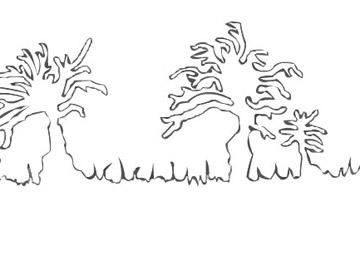
In effect, "Every Environment is Text Rich #4"
visually relays that texts are contexts themselves,
and not inanimately embedded within them - at once subverting
the canonical hierarchy of written language and visual
meaning, while making the language one filters the world
through more malleable.
It is this very malleability that speaks volumes of
the ideology of individualism and authorial intention,
two paradigms that Brooke Knight's clever piece challenges
freely and playfully. When asked what it means to be
trapped in a space, or "landscape" online,
Brooke Knight comments that, "the Internet makes
possible live representations of somhe Internet makes
possible live representations of someplace that we [the
viewers and interpreters] only have a limited knowledge
of [and] the way that I have made the project, however,
limits what can be seen, as does the angle of the cam,
and the images chosen by the viewers. It freezes those
places as well as expresses them."6 So it can be
understood, that when writers write they are also written.
In order to communicate effectively we must utilize
well-worn concepts and conventions. Unfortunately, whilst
our intention to communicate, and what we intend to
communicate, are both important to us as individuals,
meaning cannot be reduced to "authorial intention."7
Roland Barthes held the belief that it is language which
speaks, and not the individual voice of the author,
or as found in "Every Environment is Text Rich
#4," the eye of the web cam. The difficulty with
the still image, however, is that it is presupposed
to be a natural, and therefore, authoritative one. Sitting
in space, waiting to be discovered, a photograph has
the ability to toy with the senses, deceptively retrieving
from and imprinting on the mind a sense of temporality,
a solid essence. This is where the ephemeral nature
of Brooke Knight's online environment can work to exclude
definitive boundaries by way of the system of codes
used to demarcate these very boundaries themselves.
These images, no matter how fictional, are technically
embedded in a real, "hypertextual" space.
They open a whole new area of discourse on the nature
of environment, more specifically wilderness. When asked
to consider the term "wilderness," Brooke
Knight "imagine[s] something out of James Fennimore
Cooper's Leatherstocking Tales (i.e. The Last of the
Mohicans)."8 And as in the case of this romantic
tale, Brooke Knight understands that "we think
that wilderness means untamed and unbounded, but that
is just a pretty fiction."9
Footnotes:
4Knight, Brooke.
Email correspondence interview March 16 2004
5Knight, Brooke.
Email correspondence interview March 16 2004
6Knight, Brooke.
Email correspondence interview March 16 2004
7To define meaning
in terms of authorial intention is the so-called 'intentional
fallacy' identified by W K Wimsatt and M C Beardsley
of the 'New Critical' tendency in literary criticism
(Wimsatt & Beardsley 1954). We may, for instance,
communicate things without being aware of doing so
8Knight, Brooke.
Excerpt from artist statement for Digital Visions submission
9Knight, Brooke.
Email correspondence interview March 16 2004
|