Born in France, Isabel Saij currently
resides and works in Cologne, Germany and Vienna, Austria.
In the past several years, Saij began work using the
computer as a medium. Initially producing two-dimensional
work, Saij progressed into creating three-dimensional
pieces. Saij then discovered Net art while designing
her first web site. Since then, she has exhibited in
numerous online exhibitions based in various countries
around the world including the United States, Russia,
Brazil and Thailand.
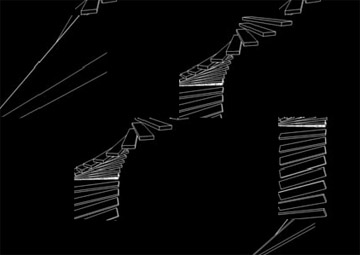
“State of Confusion” is an animated series
of staircases, in a three by four unit grid, where the
viewer moves along and through the staircases. The animation
stops when the viewer rolls their cursor over each individual
staircase, or, eventually, the animation stops independently
and loops. When initialized, each frame is staggered,
but as the viewer interacts with the piece, the pattern
changes for an infinite number of combinations. Each
staircase is black and white, much like it was created
for design purposes using AutoCAD. The viewer assumes
an almost bee-like perspective as the frame moves around,
flying amongst the stairs. Overall, “State of Confusion” is
a visually intriguing piece but also leaves the viewer
with a question, which I will examine later in this essay.
Like many art pieces, “State of Confusion” is
inspired by an intense personal experience. After moving
out of her native country, Saij experienced difficulties
having to adapt to her new environment. Her experience
was doubly complicated by her frequent travels between
the social and cultural differences of Germany and Austria.
In my correspondence with Isabel Saij, she describes
how “new symbols and new archetypes appeared” before
her and “State of Confusion” is her expression
of this experience. As Saij reiterates in her artist
statement, “every single movement leads to a loss
of reference points, to a growing disorientation, to
a topographic fragmentation…to chaos”. The
viewer starts with a clear image of the staircase, but
as each animated frame moves through its timeline, the
staircases warp and fragment, eventually breaking down
into a nonsensical image. I am sure that any viewer can
relate to the feeling of being thrust into a situation
where the environment is alien and our control over our
own situation is lost. The final statement accompanying “State
of Confusion” is Saij’s self-imposed query
of “where does it go?” The answer to where
the staircases lead can be fleshed out when we exam Net
art, as a whole, beyond the personal experience. |