|
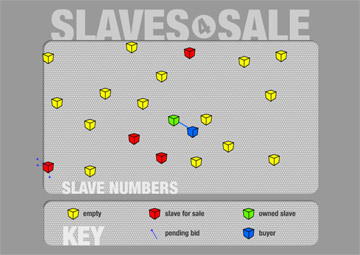
One box in particular is sure to grab the viewer's
attention and that is the creator's. In boc #20, Aceti
reveals some very personal aspects on his persona which
gives us a further glimpse into the aims and thoughts
about the piece. Aceti's box titled "If Elizabeth
2" contained personal attributes which Aceti offers
up to the prospective buyer. Conveniently divided into
categories for easy browsing, Aceti speaks of his practical
use at "social functions" and the status of
his physical health. Most intriguing was the box's title,
and while interviewing Aceti, I probed the meaning behind
his choice. Not expecting a typical response, I was
hardly disappointed in discovering the reasons behind
such a title. If Elizabeth II represents a personal
story of encounter with authority through an art piece,
and how this acts as a "[representation of] the
idea of a never realise possibility of a humane exercise
of power which, far form enslaving becomes an opportunity
of freedom, reconstruction, negotiation, and reconciliation…"
In viewing this online piece, it is important to keep
in mind the fact that this is not the piece in its entirety.
"Slaves4sale.com" is only a portion of what
Aceti terms a "hyper media" structure, an
organic entity composed of several differing media.
Aceti sees his 'hyper-media" phenomenon as a continually
developing experience, subject to interactivities as
an integral factor in the effectiveness of the piece.
Aceti's work is on of many layers and to those foreign
to the many deep-rooted influences form which it derives,
&qumany deep-rooted influences form which it derives,
"www.slaves4sale.com" may be overlooked or
unappreciated for its true depth which his entire work
conveys. This is a potential vulnerability, or a factor
which could quite possibly affect the product of the
piece itself as the work relies so much upon the viewer's
interactivity and their response.
However, Aceti seems to have taken this possible consequence
into consideration, for when asking the artist about
this issue, he responded by stating that although potentially
problematic, a viewer experiencing the piece in "fragmented
'bits'" is much reflective of our everyday existence;
"experiencing just one part of something that we
know as a whole somewhere else is what we do constantly
in our daily lives." An example of such, being
our brief interactions with others, ones in which we
only experience a portion of their multi-layered existence.
"We know [this]… but we tend to disregard
it." Thus eve if people lack the familiarity with
Aceti's art form to properly recognize its many dimensions,
this is yet another interesting manifestation of the
piece as it relates to the real world.
In fact, Aceti is quite happy with the response from
viewers thus far with the piece continuing to generate
fascinating responses. There are those who take the
website too seriously and find interacting with the
piece "unsettling and puzzling," fearing real
consequences of their actions in the virtual realm.
This, Aceti points out, is of course quite a commentary
itself on "society and out relationships with reality
and virtuality."
Through crating an online site in which an ironic twist
of slavery and the purchase of slaves potentially has
a result of setting a real slave free, Aceti touches
upon a very real and political issue. Perhaps what is
most striking is the fact that through the interactivity
of the website, there is a reflection of the past and
hope for the future in the real world as it is situation
now.
|