UBC | Digital Visions
Digital Visions
Back
 
Pablo de la Sota
View site
The Art of Pablo de la Sota

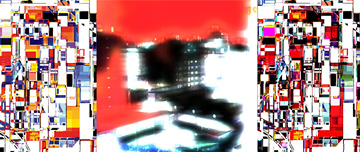
Since the 1980s Latin America has been searching for an answer to the many problems it faces. Argentina as part of Latin America has experienced in the last years perhaps one of the darkest periods of its history, sinking in a sea of desperation and unrest. On the economic side, the country that was once on equal footing to the wealthiest nations of the world, now finds itself with the highest poverty levels of all times as in three years poverty levels jumped from 19 to 52 per cent. In this obscure context arises the art of Pablo de la Sota born in Necochena 23 years ago. Although his background is not related to the visual arts, he is indeed a self-taught artist that has translated his aesthetic sensitivity and social concerns into the realm of digital arts. His images Fuimos, Robo2, and Robo3 are reflections to his sympathy for minimalist art, pure abstraction, and conceptual art.

What prompted De la Sota to express himself through the computer as a medium is unknown; however as Herbert W. Franke comments in his article entitled, the New Visual Language: The Influence of Computer Graphics on Art and Society:

“In a society in which the time for leisure is steadily increasing, the task of providing people with meaningful activities becomes more and more important. A greater share of it will fall to art, a distinctive manifestation of art different from the classical sense which restricts the spectator to the role of a passive consumer, but more an art which will stimulate him to participate creatively. In this regard computer art offers the best conditions. Forms of aesthetic activity can be imagined which allow the viewer to enter into a sort of dialogue with the computer or the aesthetic program; by interaction some sort of a play with graphic structures may emerge. As experience has shown, such activity is not only pleasurable but has also positive effects on the creative capabilities.” (Digital Arts Museum).

Many of these notions applied to the case of Pablo de la Sota with an evident exception in relation to what generates time off and the need to find a creative and productive outlet. As the artist recalls:

“My interest for the arts came recently, as a natural response to the growing anxieties and frustrations generated by the many filters, obstacles, revisions, that as a creative publicist (copy writer) I had to endure day after day fighting to do something different. These things and the abrupt fall in the advertising industry in Argentina push me to explore other paths.”

Hence, in societies in turmoil such as the Argentinean case, art aside from being a pleasurable activity it is also highly motivated by social and political activism prompted by the frustration of unemployment and the limitations that a country without opportunities offers to skilled labor, and to the existing pool of unemployed professionals.

An additional stimulus was created by the advancement of microelectronics and the accessibility of personal computers which are constantly adding new dimensions of artistic activity. By increasing both execution speed and memory size, it became possible to modify the images on the screen so rapidly as to simulate continuous movement. Most of the classic branches of art cannot really be mastered before the hurdle of technical and manual skills have been overcome. Contrary to this, the computer is able to generate complex artistic results within a very short time, granting the author a sense of achievement. The demands made by computer art are transformed from manual dexterity to the capabilities of the mind such as imagination, creativity, and self-critical assessment.

 
next 1 | 2 | 3
Site: http://www.artistsite.com