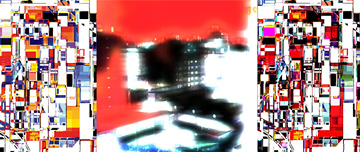
Digital Arts represents for de la
Sota the possibility of creation without impositions
and without
limits. Although, he does not considered himself an
artist of any medium there is clear artistic sensitivity
tinted
with minimalist style in his digital images. A common
thread in his work is the notion of fragmentation of
geometrical elements such as the small squares of different
sizes depicted in Robo2 and Robo3. The artist admits
that the fragmentation is a reflection of the society
and the chaotic situation of his country. Red is a
predominant color throughout the plane, perhaps a reminiscent
of
the violent past associated with the years of the dictatorship
and the fatal outcome of the Balkan war. His image
Fuimos whose title means We were already implies a
look to the
past a sense of nostalgia perhaps for those years of
economic development, and the sophistication of the
Buenos Aires of the early 20th century, once considered
the “the
Paris of America”. The blur look of the image
Fuimos brings again the issue of uncertainty and hopelessness.
The picture posses a lack of definition of the different
elements, an urban landscape, images of modernity.
The
composition is divided in two, the urban details in
the left and an empty right side, perhaps suggesting
a juxtaposition
between a prosperous past and the scarcity of the present.
The multiplicity of boxes in Robo2 and Robo3 could be
interpreted as the rigidity of the politics, in many
respects imposed from abroad, that has brought the country
to its knees. It also suggests that the country did not
have a coherent vision of its path. Today’s attempt
to gear the Argentinean political and economical future
seems to be additional patches to fix immediate problems,
similar to a quilt knitted with an unclear pattern in
mind. Both Robo2 and Robo3 are basically a repeated pattern
modified only by color, from red to yellow. The slight
difference between the pieces can be tied to the artist’s
opinion in relation to the country’s changes which
are not of significant magnitudes but rather superficial,
a relief and not a cure. One of the most eloquent examples
about this issue is the next presidential election that
is to be held in December 2003 in which ironically Carlos
Menem the former president is again a candidate. What
is clear is that the political class in Argentina has
no credibility with the Argentinean people. The Peronista party, under Menem, had been in power for 10 years (1989-99)
before being succeeded by an alliance of the Radical
Party and a coalition of centre-left parties led by de
la Rua, which was in turn forced out of office. The current
president is Eduardo Duhalde, another Peronista, who
is scheduled to see off de la Rua’s term. The government
is on shaky ground and power is very much on the streets.
Although the artist does not associate his work with
any artistic movement the arrangement of elements in
Robo2 and Robo3 suggest a possible echo on an influential
artist from the Rio de la Plata region, the Uruguayan
painter Joaquin Torres Garcia. He developed a unique
visual language based upon the squares and intersecting
lines. They are flat spaces in which a multiplicity of
symbols and ideas connected to Latin American derived
from classicism, primitivism, pre-Columbian art, Neo
Platonism, Cubism and surrealism (Sullivan, 266-267).
Robo2 and Robo3 are particularly reminiscent of the geometric
and compositional qualities of Torres Garcia. What is
clearly distinctive in the la Sota approach is the absence
of symbols of universal recognitions since the images
are above all abstract manifestation based upon free
experimentation, intuition and scribbles.
|